Friday, 20 April 2012

HR: [QUESTION 3] What media institution might distribute your media product and why?

  • The cheapest and easiest way that we could distribute our zombie horror film would be by viral marketing by web 2.0, making the film available for free on a video sharing site such as YouTube. This way, we could create a buzz worldwide as it would be readily available to everyone and it would not cost our audience any money to watch it.

  • A majority of independent film makers would be interested in low budget films as their ethos is to show talent available to up and coming film makers with low budgets. A film company that I think would be interested in distributing Gutted would be Arrow Films which is is one of the UK's leading independent distributors of world cinema, arthouse, horror and classic films so this would be ideal as they are British so they would be more willing to accept our film than a Hollywood blockbuster. As one of the genres that they specialise in distributing is horror, I feel this would fit with the style of our piece.

Such horror films created by Arrow Films include Midnight (Russo, 1982) and Vamp (Wenk, 1986)


    A more well know distribution company that may be interested in our film is one called Vertigo Films founded in 2002 by Allan Niblo. Not only does is produce the content, but also distributes it and makes sure that the film is mostly British to fit with their ethos and to get rid of the "glitz factor" involved in film making so the film is low budget with high production values. This company would be a contender for our film as it takes on low budget films and helps them to become a success.

Such horror films created by Vertigo Films include Outcast (McCarthy, 2010) and
The Children (Shankland, 2008)


  • We could exhibit our film at a local theatre such as Trinity Arts Theatre or the Assembly Hall, both in Royal Tunbridge Wells as they would welcome local projects to show the rest of the community so they can see their town being put into a film. Arthouse cinemas openly welcome unknown film makers so this could be an advantage if we decide to exhibit our film opening as there is a less chance that we will be turned down.
  • Following on from this, our film is digital so not all small arthouse cinemas will have the ability to show these types of film as they may still have 35mm film projectors, so we would want to exhibit our film in a chain cinema such as Odeon which have the facilities to show digital film. This would also make exhibition a lot faster and quicker and less likely for people to pirate as we could release the film at the same date in all countries. To limit piracy further, we would have a small gap between the last showing of the film and the release date of the DVD.

RA: [QUESTION 3] What media institution might distribute your media product and why?

Left Films are a UK independent distributor of horror, action and sci-fi films. Left films distribute in cinemas, on DVD and download. Their previous titles include Cowboys & Zombies (Perez, 2011) and the film Memory Lane (Holmes, 2012). Memory Lane had a micro-budget of only $300. Left Films has received the NESTA Insight Out award to Innovation in creative industries.

I feel that this distributor would be suited to our project as it is UK based, so would be easier to contact and collaborate with than one overseas, they specialise in independent film, which mean they will have a good understanding of our film, as a micro-budget horror, and how best to market it. The fact that they distribute to cinema, DVD and download will allow us to reach a wider audience, as even if our cinema release is small, the film can be accessed globally via the internet.


As well as securing a distributor, I would also try to screen our film at as many film festivals as we can. If we failed to first get the attention of Left Films or a similar institution, there will be many distributors at festivals that could potentially approach us. As well as this, by screening your film at festivals you can gain a fan-base for your film, create buzz, and even win awards, which will open doors in terms of acquiring a distributor, and will help to market the film if potential audience can see that the film has critical acclaim.

Memory Lane has achieved success in this way, showing at many festivals, from Cannes to Sci-Fi London. The positive reviews it has received from these screenings has helped it to generate a buzz. This is something that we would aim to replicate with the distribution and marketing of 'Gutted.'


Lastly, we would create a viral marketing campaign using web 2.0. This is a really effective way of gaining and engaging audience without expense. To do this, we would upload our trailer to Youtube, create Facebook, Twitter and Tumblr pages for our film and encourage fans to 'like' or follow these pages, which will promote the pages to other social network users.

Wednesday, 18 April 2012

HR: [QUESTION 2] How does your media product represent particular social groups?


  • In our film opening, our protagonists are middle class British females. We represent this social group as brave and strong which is unconventional of a horror film as the females are usually the victims or are there for their sex appeal.
  • The first antagonist that you see is a male. Within this sequence, he is the only antagonist of this gender so this represents men as menacing and devious. It also increases the tension as he is chasing the females and the audience don't know if he is going to catch up with them. 

  • The other males in our piece are corpses on the floor devoured by the zombies, so this represents men as victims, so one reading of this is that they were trying to protect the other two female corpses but failed or other is that they are prone victims due to their vulnerability.


  • The other two zombies in our piece were female and you don't see them until the protagonists get to the graveyard, so these zombies are following the male zombie which represents females as obedient and not independent as if they have to rely on the male on what to do which is a residual ideology as not many females these days think like this. Other reading of this is that the female zombies knew exactly what they had to do without needing the assistant of the male because as soon as the protagonists entered the graveyard they ran towards them.
  • We didn't use any adults in our piece as we wanted to keep to our target audience of 12-29 year old so we felt in order for them to relate to the characters more they would have to be within that age group so we used teenagers and children.
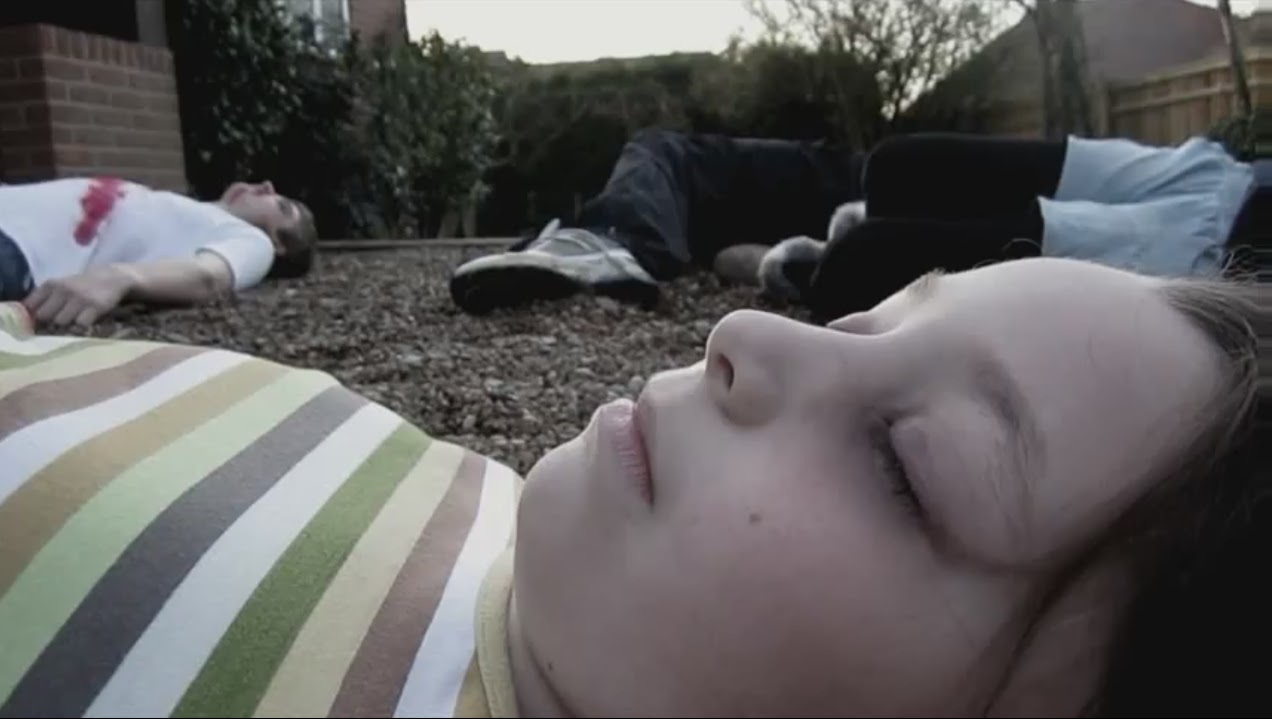
  • The first shot of our opening is a close up of a corpse of a young girl, so this positions the audience to have an emotional response as children are represented as defenceless and weak. Of the the corpses on the ground, two of them are young girls.

RA: [QUESTION 2] How does your media product represent particular social groups?

What social groups are present in our opening?
The protagonists are all:
  • Females
  • Teenagers
  • Middle class
  • White
Males are present in our opening as two of the corpses and the main zombie.
The zombies are also teenagers, and two of the corpses are children. There are no adults present in our opening.

How are the social groups represented? Are they depicting traditional gender roles or challenging social norms?
  • The young females are represented as strong and intelligent, as they are the only known survivors of the apocalypse. This is an example of emergent ideology in our piece. In many texts, female protagonists are either love interests for the male characters, or in need of being saved: the 'damsel in distress' stereotype. This therefore challenges traditional gender roles of women being reliant on men.
  • One reading of our opening could be that males are antagonised as the only male character in the opening is that of the main zombie.
  • The fact that the only survivors are young females challenges social norms, as you would probably expect the most strong, intelligent and capable social type to be an adult male.

How is this representation constructed in the opening?
Mise-en-scene
The costumes of the protagonists represent them as strong and realistic women, as they are all wearing jeans or shorts. Often in films, teenage girls would have a costume of skirts or dresses which represent them as feminine or sexualised, so our characters are anti-stereotypical in this way.


Non-Verbal Language
Our protagonists, particularly Imogen and Alexis, seem unafraid by the situation they've found themselves in at the beginning of the piece. We can see this from their stoic facial expression and nonchalant posture. This connotes a fearless element, making the protagonists seem strong and heroic.


Sound
Alexis' dialogue in her monologue presents her as the leader of the group, connoting her mental strength, intelligence and bravery. It also creates character exposition for her character, which positions the audience with her, creating empathy for the female protagonist. She is also the first person to speak within the opening, which represents her as the main character of the film.


Camera
The very first shot of the opening is a close-up of a dead girl on the floor. This immediately presents connotations of a sinister and evil situation, as children- particularly little girls- represent innocence and happiness. So this use of semiotics creates a feeling of fear in the audience.


Editing
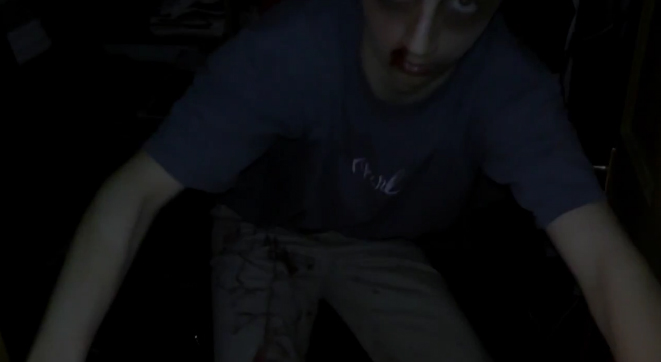
In post-production, we darkened the footage of the first time you see the zombie in the doorway. We did this to give the introduction of the zombie a menacing and dark feeling. The footage is also cropped so as to show a disjointed view of the zombie, creating fear of the unknown.

Tuesday, 17 April 2012

Group: How did you attract/address your audience?

  • As our target audience are the core audience of 12-29 year olds, we felt in order to create an interest in our film we would use teenage protagonists so that the audience would be able to relate to them.

  • The fact that we used female protagonists instead of male ones will hopefully attract both genders as the females will be glad to see a strong female characters while males are interested in horror films so they would naturally be interested as most film companies target horror films to the male audiences.
  • In order to create a buzz, we would market our product online by Web 2.0 on social networking sites such as Facebook, YouTube and Twitter to attract our audience.
  • Audiences who are interested in a more realistic interpretation of a horror film will be attracted to this as we use handicam shots which makes a film appear to be more lifelike as it is more difficult to add special effects to a camera that is constantly moving and not stable with a tripod.

Thursday, 29 March 2012

RA: [QUESTION 1] In what ways does your media product use, develop or challengeforms and conventions of real media products?

Horror/Slasher Conventions in 'Gutted'


Character
  • The three protagonists in our opening are all female. This is conventional of many horror films, such as Scream (Craven, 1996) and The Ring (Verbinski, 2002).

Alexis, Imogen & Sophie of Gutted

'Sidney,' the protagonist in Scream
Plot
  • In 'Gutted,' the antagonists are undead zombie creatures. Zombie films are a popular subgenre of horror, with notable films such as Dawn of the Dead (Snyder, 2004).
    A zombie in Gutted
  • Within the opening sequence, Sophie, one of the protagonists, is killed. This is conventional for many horrors, such as the Scream trilogy (Craven, 1996-2000), in which a character- usually female- is killed within the opening sequence. This technique is used to create fear early on in the film, to establish the genre and scare the audience.

Mise-en-scene
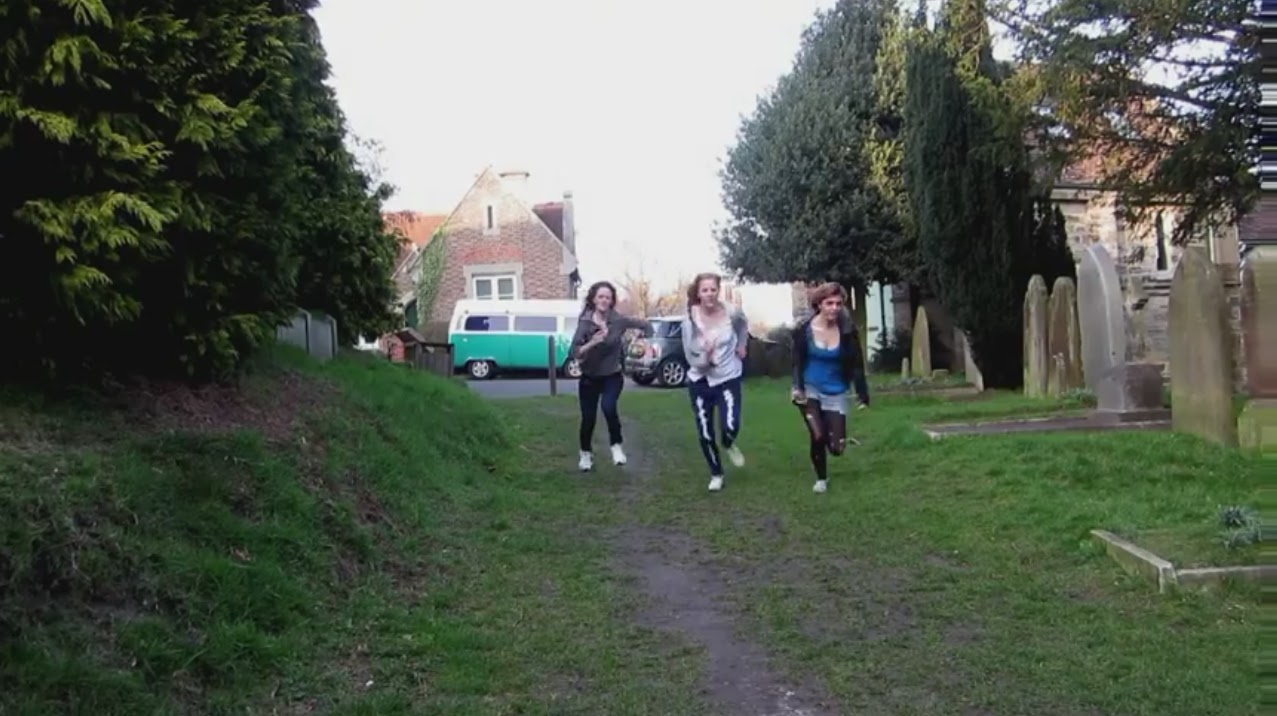
  • The chase half of the opening is set in a graveyard, which is a frequently used location in horror films, because of it's connotations of death.
  • The costumes of the zombies are ripped and bloodstained, which is conventional for many zombie films, such as Dawn of the Dead (Snyder, 2004)
Zombies in Dawn of The Dead
Sound
  • We used non-diagetic sound in our opening in the form of a royalty-free soundtrack. Almost all film openings of any genre will include a soundtrack of music or at least some non-diagetic sound to create an opening with more dimensions.
  • The soundtrack we chose was low and ominous in the slower parts, and suspenseful during the chase, adding to the tension of the opening; conventional for a horror film.

Camera Work
  • A significant part of our opening consists of Alexis' dialogue in the form of a video diary, which involved our actress operating the camera herself while talking into it to give a realistic effect. This use of handicam positions the audience with the protagonist, as it breaks the fourth wall
    Alexis' handicam in Gutted
  • Similar techniques can be noted in films such as Cloverfield (Reeves, 2008) and Blair Witch Project (Myrick/Sánchez, 1999)
    Handicam techniques in Cloverfield
Editing Style
  • We used a fast cutting rate in our opening which gained speed as time went on, particularly during the chase scenes. This is a common technique used in horror openings; beginning slowly then increasing the pace to a climax at the end of the opening.
  • A good example of this is the opening of Scream (Craven, 1996), which begins with a girl making popcorn and end with her hanging dead from a tree. 

Colour
  • In post-production, we edited the footage to bring the saturation down, particularly in the initial outside scene, to make the corpses look more realistic as well as creating a more filmic and atmospheric look.
    Drained colouring in Gutted
  • In graveyard scenes, we darkened the clips slightly to create a more intense visual.

Visual Techniques
  • Showing 'gore' is a vital part of any zombie film. We used prosthetic intestines which I made with liquid latex to add the gruesome zombie element to our opening.
Gore in Gutted

HR: [QUESTION 1] In what ways does your media product use, develop or challengeforms and conventions of real media products?

  • The establishing shot that we see in our horror opening is a corpse of a young girl. Compared to the openings that we studied, it does not conform with the conventions of an opening as tension is usually built up to a death rather than seeing someone already dead.

  • Much like Scream 2 (Craven, 1997) horror film opening, there is a death at the end before the titles of the film show in our opening. We decided to stick to this convention as it would be easier to build up tension through music, pace and diagetic sounds before the death so it appeared to be more shocking than just a couple of teenage girls exploring a house and there being no zombies.


  • Moving on to the point of gender, usually in a horror film opening there is a victim that is female. As our three protagonists are female which challenges usual conventions, we decided a death within the opening would provide the audience with a interest to carry on watching the film and to see what happens to the two remaining survivors in the rest of the film.
  • We used more dialogue than you would usually expect in an opening so the audience know what is going on in the plot. We made this work by the protagonists documenting on cameras and incorporating this into the opening to explain the scenario.


  • We went for a desaturated colour scheme to make the mise-en-scene seem more eerie and dark and for the corpses to appear more dead, like the colour had been taken from them by the zombies.
  • The music used was tension building which helped to create enigma as the audience were aware that something was about to happen, but did not know when. We went for a high pitched, morbid, obscure track with the chase scene and death scene as this made the scene seem more manic and out of control. This style of music was similar to Seven (1995, Fincher) which we studied in our research. For the exploring of the house, we chose low pitched stringed instruments as we felt this gave a good atmospheric horror feel to the piece.


  • We used a lot of canted angles and unusual camera angles as this helped to heighten the chaos of the situation and to visually show the audience how the characters see the situation. For example, the handicam shots used by the protagonists. We got this idea of filming from Amityville (2005, Douglas) as it would make our piece seem more realistic

  • For locations, we decided to stick to the conventions of a horror opening by using an isolated house and a graveyard as these connote fear of the unknown which is what we want our audience to feel.