Friday, 20 April 2012

RA: [QUESTION 6] What have you learnt about technologies from the process of constructing this product?

Online

  • Blogger
At the very beginning of the course, we set up this account on blogger to document our progress throughout the project. We uploaded blog posts, photos, videos, links, and formatted these with highlighting and embedding. We were also able to comment on the posts, which allowed us to give feedback on each others' work and develop our ideas.
  • Surveymonkey
We used the website Survey Monkey to create our audience research questionnaires. This was very useful as the website allows you to create different types of question, and can then display the results graphically and calculate percentages. Our first Survey Monkey questionnaire can be found here, and the second here.
  • YouTube
We used YouTube to upload videos we made throughout the process of making our opening, including our preliminary task, Wilderness Woods footage, animatic and final piece. We also used it for watching opening sequences during the planning stage. Another website I used for this purpose was Art of the Title. Youtube was also used to research and locate our soundtrack.
  • Slideshare & Prezzi powerpoints for our initial pitch and other work.
  • Dafont to research and download appropriate fonts for our titles.

Camera


For our opening we used a Canon IXUS 115 HS and a Panasonic HDC SD-80, as well as a Sony Bloggie which was used for the characters' personal handicam shots. By using both of these cameras, we achieved good quality footage in HD, as well as the audio recordings. It also allowed us to film the handicam POV shots and regular shots simultaneously, which helped create continuity when editing.

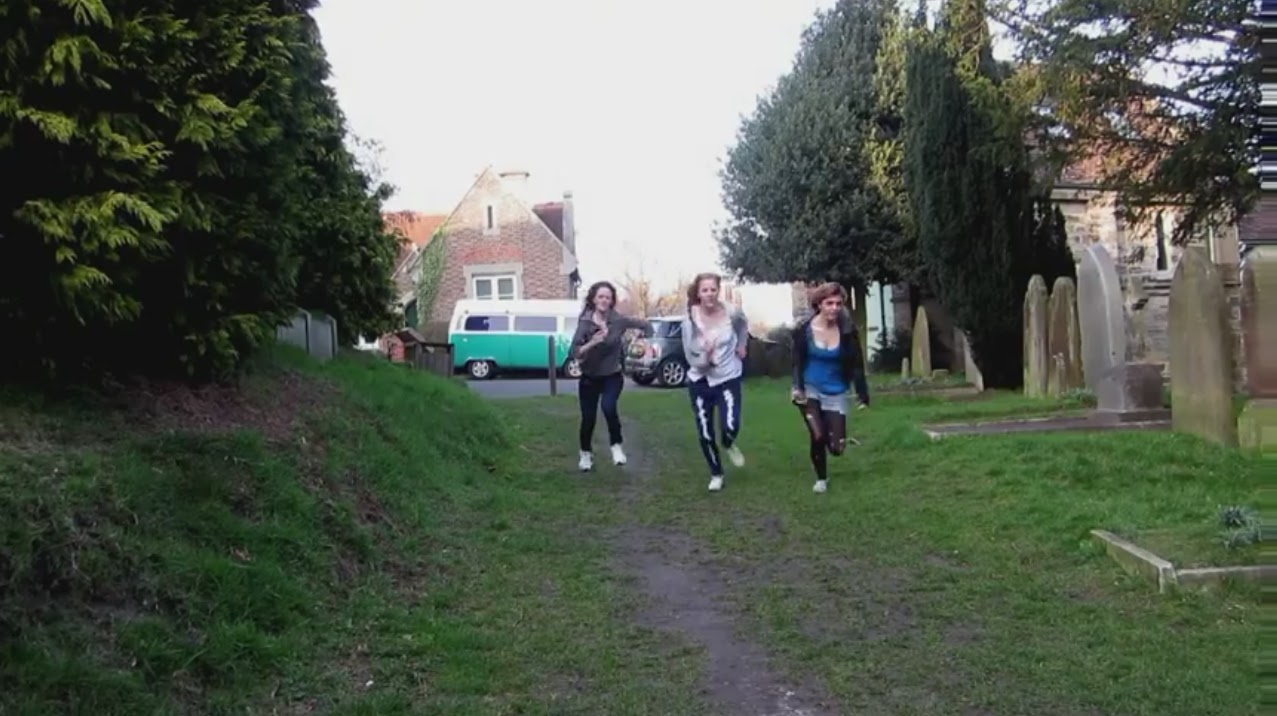
For many of the shots, we used a tripod to create smooth and professional looking shots. However, we also felt it was appropriate to use handicam as it fitted with the frantic feel of the chase scene, as well as creating verisimilitude during parts where the characters are filming themselves as part of the plot.


Editing
We used the software Adobe Premiere Elements 9.0 to edit our opening. The process of editing 'Gutted' involved:
  1. Uploading all of the footage we want to use onto the Data Disk of our editing computer. From here we imported the footage into Premiere Elements. We then pulled the footage onto the timeline in chronological order. For many parts we had multiple takes or different angles, so it was here that we chose which footage worked best for each part of the opening.
  2. Next, we cut and trimmed our clips to create continuity, a clear narrative, and the appropriate pace for our opening. We wanted the piece to begin slowly, with longer length of takes, and to gain speed throughout opening until the title.
  3. After this, we adapted colouring, speed, zoom and other alterations you can make to the clips in post production where we saw appropriate.
  4. We then added soundtrack that we had sourced online. The soundtrack consisted of one piece of music, which we cut into three different parts to fit the feel and pace of different parts of the opening. We also added the sound effect of birdsong during the establishing outdoor scene to create an audio bridge between shots, but we slowed the audio down slightly to create a slightly more sinister sound.
  5. When adding non-diagetic sound, we also had to edit the existing sound. In some places, we quietened or muted the sound all-together, such as during the chase scene, whereas in other parts we amplified the sound to heighten the effect, notably the final scream as the title is shown. Other sound we added was the dialogue "Run!" which we recorded separately to add a transition between the two locations; the house and the cemetery.
  6. Lastly we added titles. This took more than one attempt to perfect. From the start we knew we wanted to use the font gogozombie, so we placed the titles throughout in this font. However, we found that including titles once the zombie chase had started distracted from the action. So we removed some titles and moved others to earlier in the piece while the tension was building. We also had to conform the titles by keeping them in similar places on the screen and making them roughly the same length.
Effects we added in post-production:
  • For the outside footage at the beginning we wanted to drain the colour. We did this using the brightness and contrast, saturation, and lightness tools.
  • To make Alexis' handicam monologue look realistic as being filmed on a camcorder, we applied the 'old film' filter and adjusted the gamma settings to make the footage look grainy and damaged.
  • To increase the pace of the opening, we sped some of the footage up using the 'compress time' tool.
  • We used keyframes to fade the titles in and out to create a smoother look.

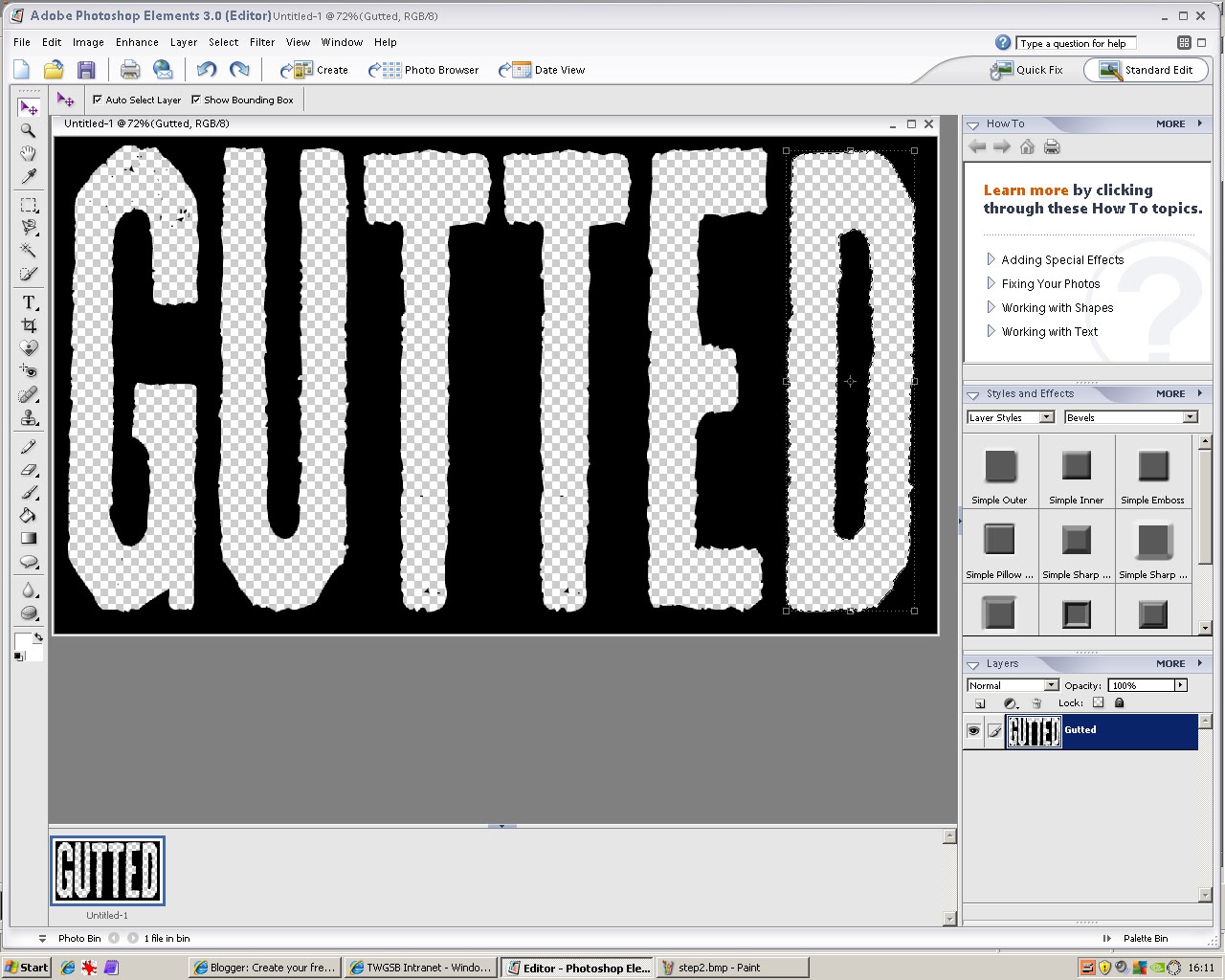
We created the effect on the final title, “GUTTED” using a number of steps:
  • Firstly, we used the Black & White and Colour Pass tools to show only the red colours in the footage. 
  • Then, using Adobe Photoshop, we created a stencil of the word 'GUTTED' in our desired font, Skin & Bones. 
  • We then imported it into Premiere Elements and added it to the timeline as another layer of video above the last clip. We added the zooming effect to this layer.
  • Lastly, we added a final video layer of a blood-red colour, and used keyframes and the fading tools to create the fade from the footage into the solid colour.

HR: [QUESTION 6] What have you learnt about technologies from the process of constructing this product?

  • During this process, we have used a wide variety of different medias to conduct our project. The first piece of technology we used was a Panasonic HDC SD-10 for our preliminary task. We edited it with Adobe Premiere Elements 9.0, the same software we used for our opening sequence. We made no changes to the colouring or sound as we were mainly focusing on the potential types of camera angles we could have use. We later used this camera to film our audience immediate response and our question 7 evaluation.


  • To analyse the different openings to give us inspiration for our opening, we embedded clips from YouTube onto Blogger to make it look more organised and neat, plus it makes watching the clips easier.
  • Also when we were analysing the clips, we took screen shots of the opening, pasting them into Paint and uploading the pictures onto Blogger to make the post have multimedia.
  • For the presentation to get the green light, we used PowerPoint presentation to present our ideas to the rest of the class and we uploaded this onto SlideShare to then put on the blog rather than doing many screen shots.
  • Another piece of online software we used was survey monkey to get audience research prior to film making and audience feedback for our film. This way it allows us to analyse the results easily and to adapt it to how we wanted. 
  • For the actual filming, we used three different cameras: Panasonic HDC SD-80, Sony Bloggie, Canon IXUS 115 HS and for one small sound clip, an HTC Desire HD smart phone. These all film in high definition so continuity editing was not really a problem.
  •  


  • As previously mentioned, the editing software that we used to edit our opening was Adobe Premiere Elements 9.0. We used a variety of techniques within the software to help our film more cinematic.We did this by altering the brightness and contrast, saturation and lightness to make continuity fluent.
  • To distinguish between the two cameras used by the girls, for one camera we added a layer onto the clip to make it have a camera battery icon and a record button onscreen. For the other camera, we altered the quality of the clip by adding an old film style effect on top and changing the gamma.
  • For some of the dialogue, we took the sound from one clip and put it over another ones for example when the protagonists are trying to escape from the house. To keep continuity the same so the shouts were not choppy, we chose the best sound from all the takes we did and put it over the clip. We used this method several times in our opening, another example being the screams at the end of the opening when one of the protagonists die.
  • For our titles, we used two both downloaded from DaFont, one called "gogo zombie" (for the initial titles) and the other called "skin & bones" (for the film title). The first being the titles within the opening showing director, editor and the actors names. We layered this and positioned them in places that appeared to be bare, then changed them by adding a shadow effect onto them so they would show up more easily. To make the transitions smooth, we made them fade in and out making sure they lasted for around the same time periods.

  • For the film title, we used a stencil made in Photoshop which could allow us to show the footage through each of the letters as it zoomed in to reveal the title: Gutted. 
  • The music in our piece was downloaded through video2mp3.net  and was placed on a separate track on Adobe Premiere Elements so it would not get confused with the dialogue and sounds in the other clips. The two sounds we used were the sound of a blackbird singing so the beginning scene had a sound bridge rather than being in silence and the second piece being our main background music. We had to change the volume for some parts of the opening so it would not conflict with other sounds on top. For the chase scene we made the sound as loud as we possibly could in order to connote fear and tension.

HR: [QUESTION 3] What media institution might distribute your media product and why?

  • The cheapest and easiest way that we could distribute our zombie horror film would be by viral marketing by web 2.0, making the film available for free on a video sharing site such as YouTube. This way, we could create a buzz worldwide as it would be readily available to everyone and it would not cost our audience any money to watch it.

  • A majority of independent film makers would be interested in low budget films as their ethos is to show talent available to up and coming film makers with low budgets. A film company that I think would be interested in distributing Gutted would be Arrow Films which is is one of the UK's leading independent distributors of world cinema, arthouse, horror and classic films so this would be ideal as they are British so they would be more willing to accept our film than a Hollywood blockbuster. As one of the genres that they specialise in distributing is horror, I feel this would fit with the style of our piece.

Such horror films created by Arrow Films include Midnight (Russo, 1982) and Vamp (Wenk, 1986)


    A more well know distribution company that may be interested in our film is one called Vertigo Films founded in 2002 by Allan Niblo. Not only does is produce the content, but also distributes it and makes sure that the film is mostly British to fit with their ethos and to get rid of the "glitz factor" involved in film making so the film is low budget with high production values. This company would be a contender for our film as it takes on low budget films and helps them to become a success.

Such horror films created by Vertigo Films include Outcast (McCarthy, 2010) and
The Children (Shankland, 2008)


  • We could exhibit our film at a local theatre such as Trinity Arts Theatre or the Assembly Hall, both in Royal Tunbridge Wells as they would welcome local projects to show the rest of the community so they can see their town being put into a film. Arthouse cinemas openly welcome unknown film makers so this could be an advantage if we decide to exhibit our film opening as there is a less chance that we will be turned down.
  • Following on from this, our film is digital so not all small arthouse cinemas will have the ability to show these types of film as they may still have 35mm film projectors, so we would want to exhibit our film in a chain cinema such as Odeon which have the facilities to show digital film. This would also make exhibition a lot faster and quicker and less likely for people to pirate as we could release the film at the same date in all countries. To limit piracy further, we would have a small gap between the last showing of the film and the release date of the DVD.

RA: [QUESTION 3] What media institution might distribute your media product and why?

Left Films are a UK independent distributor of horror, action and sci-fi films. Left films distribute in cinemas, on DVD and download. Their previous titles include Cowboys & Zombies (Perez, 2011) and the film Memory Lane (Holmes, 2012). Memory Lane had a micro-budget of only $300. Left Films has received the NESTA Insight Out award to Innovation in creative industries.

I feel that this distributor would be suited to our project as it is UK based, so would be easier to contact and collaborate with than one overseas, they specialise in independent film, which mean they will have a good understanding of our film, as a micro-budget horror, and how best to market it. The fact that they distribute to cinema, DVD and download will allow us to reach a wider audience, as even if our cinema release is small, the film can be accessed globally via the internet.


As well as securing a distributor, I would also try to screen our film at as many film festivals as we can. If we failed to first get the attention of Left Films or a similar institution, there will be many distributors at festivals that could potentially approach us. As well as this, by screening your film at festivals you can gain a fan-base for your film, create buzz, and even win awards, which will open doors in terms of acquiring a distributor, and will help to market the film if potential audience can see that the film has critical acclaim.

Memory Lane has achieved success in this way, showing at many festivals, from Cannes to Sci-Fi London. The positive reviews it has received from these screenings has helped it to generate a buzz. This is something that we would aim to replicate with the distribution and marketing of 'Gutted.'


Lastly, we would create a viral marketing campaign using web 2.0. This is a really effective way of gaining and engaging audience without expense. To do this, we would upload our trailer to Youtube, create Facebook, Twitter and Tumblr pages for our film and encourage fans to 'like' or follow these pages, which will promote the pages to other social network users.

Wednesday, 18 April 2012

HR: [QUESTION 2] How does your media product represent particular social groups?


  • In our film opening, our protagonists are middle class British females. We represent this social group as brave and strong which is unconventional of a horror film as the females are usually the victims or are there for their sex appeal.
  • The first antagonist that you see is a male. Within this sequence, he is the only antagonist of this gender so this represents men as menacing and devious. It also increases the tension as he is chasing the females and the audience don't know if he is going to catch up with them. 

  • The other males in our piece are corpses on the floor devoured by the zombies, so this represents men as victims, so one reading of this is that they were trying to protect the other two female corpses but failed or other is that they are prone victims due to their vulnerability.


  • The other two zombies in our piece were female and you don't see them until the protagonists get to the graveyard, so these zombies are following the male zombie which represents females as obedient and not independent as if they have to rely on the male on what to do which is a residual ideology as not many females these days think like this. Other reading of this is that the female zombies knew exactly what they had to do without needing the assistant of the male because as soon as the protagonists entered the graveyard they ran towards them.
  • We didn't use any adults in our piece as we wanted to keep to our target audience of 12-29 year old so we felt in order for them to relate to the characters more they would have to be within that age group so we used teenagers and children.
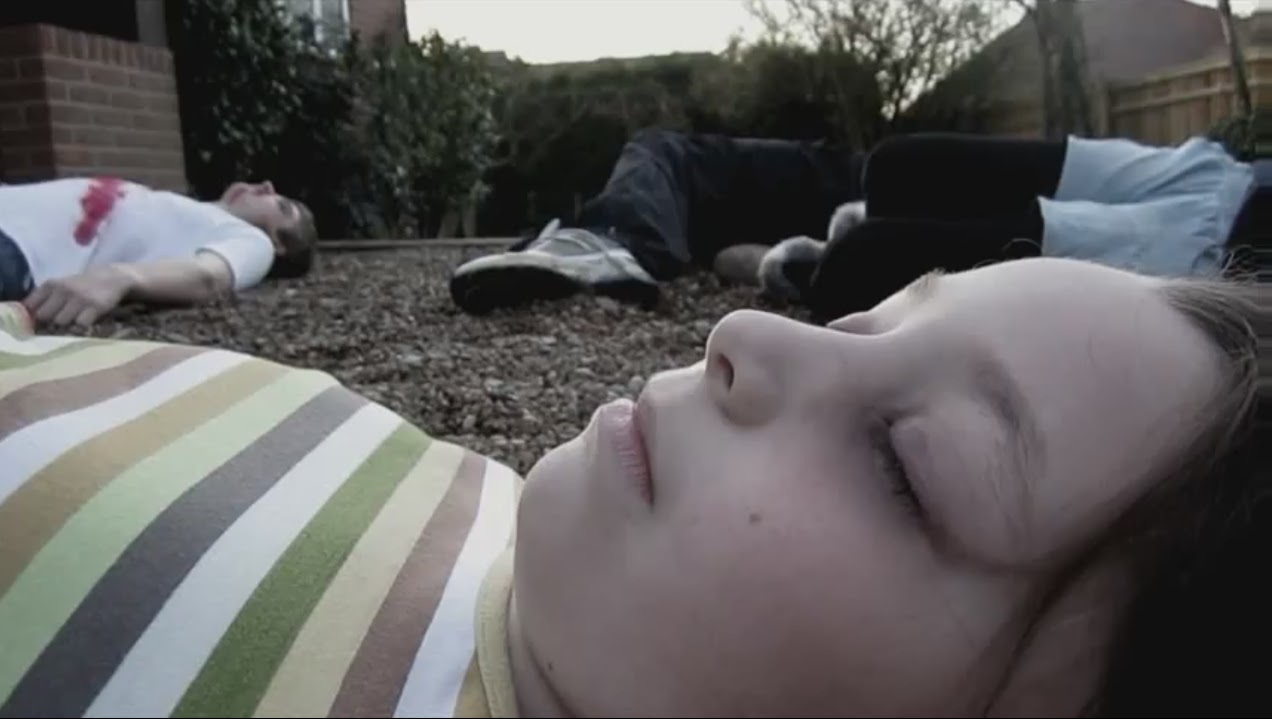
  • The first shot of our opening is a close up of a corpse of a young girl, so this positions the audience to have an emotional response as children are represented as defenceless and weak. Of the the corpses on the ground, two of them are young girls.

RA: [QUESTION 2] How does your media product represent particular social groups?

What social groups are present in our opening?
The protagonists are all:
  • Females
  • Teenagers
  • Middle class
  • White
Males are present in our opening as two of the corpses and the main zombie.
The zombies are also teenagers, and two of the corpses are children. There are no adults present in our opening.

How are the social groups represented? Are they depicting traditional gender roles or challenging social norms?
  • The young females are represented as strong and intelligent, as they are the only known survivors of the apocalypse. This is an example of emergent ideology in our piece. In many texts, female protagonists are either love interests for the male characters, or in need of being saved: the 'damsel in distress' stereotype. This therefore challenges traditional gender roles of women being reliant on men.
  • One reading of our opening could be that males are antagonised as the only male character in the opening is that of the main zombie.
  • The fact that the only survivors are young females challenges social norms, as you would probably expect the most strong, intelligent and capable social type to be an adult male.

How is this representation constructed in the opening?
Mise-en-scene
The costumes of the protagonists represent them as strong and realistic women, as they are all wearing jeans or shorts. Often in films, teenage girls would have a costume of skirts or dresses which represent them as feminine or sexualised, so our characters are anti-stereotypical in this way.


Non-Verbal Language
Our protagonists, particularly Imogen and Alexis, seem unafraid by the situation they've found themselves in at the beginning of the piece. We can see this from their stoic facial expression and nonchalant posture. This connotes a fearless element, making the protagonists seem strong and heroic.


Sound
Alexis' dialogue in her monologue presents her as the leader of the group, connoting her mental strength, intelligence and bravery. It also creates character exposition for her character, which positions the audience with her, creating empathy for the female protagonist. She is also the first person to speak within the opening, which represents her as the main character of the film.


Camera
The very first shot of the opening is a close-up of a dead girl on the floor. This immediately presents connotations of a sinister and evil situation, as children- particularly little girls- represent innocence and happiness. So this use of semiotics creates a feeling of fear in the audience.


Editing
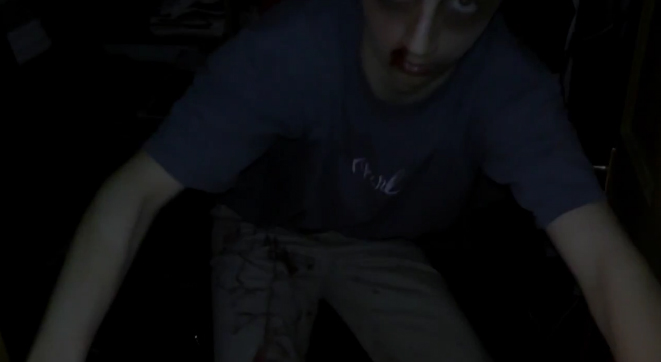
In post-production, we darkened the footage of the first time you see the zombie in the doorway. We did this to give the introduction of the zombie a menacing and dark feeling. The footage is also cropped so as to show a disjointed view of the zombie, creating fear of the unknown.

Tuesday, 17 April 2012

Group: How did you attract/address your audience?

  • As our target audience are the core audience of 12-29 year olds, we felt in order to create an interest in our film we would use teenage protagonists so that the audience would be able to relate to them.

  • The fact that we used female protagonists instead of male ones will hopefully attract both genders as the females will be glad to see a strong female characters while males are interested in horror films so they would naturally be interested as most film companies target horror films to the male audiences.
  • In order to create a buzz, we would market our product online by Web 2.0 on social networking sites such as Facebook, YouTube and Twitter to attract our audience.
  • Audiences who are interested in a more realistic interpretation of a horror film will be attracted to this as we use handicam shots which makes a film appear to be more lifelike as it is more difficult to add special effects to a camera that is constantly moving and not stable with a tripod.